
Why Solder Tip Technology Is More Important Today Than Pure Power
Modern assemblies place ever-increasing demands on the manual soldering process. Smaller components, higher packing densities, sensitive components, and thermally demanding ground planes require precise and stable heat transfer.
While the focus used to be primarily on the performance of a soldering station, the technology used in the soldering tips is becoming increasingly important today. It has a significant impact on the heating rate, temperature stability, heat transfer, and responsiveness of the system.
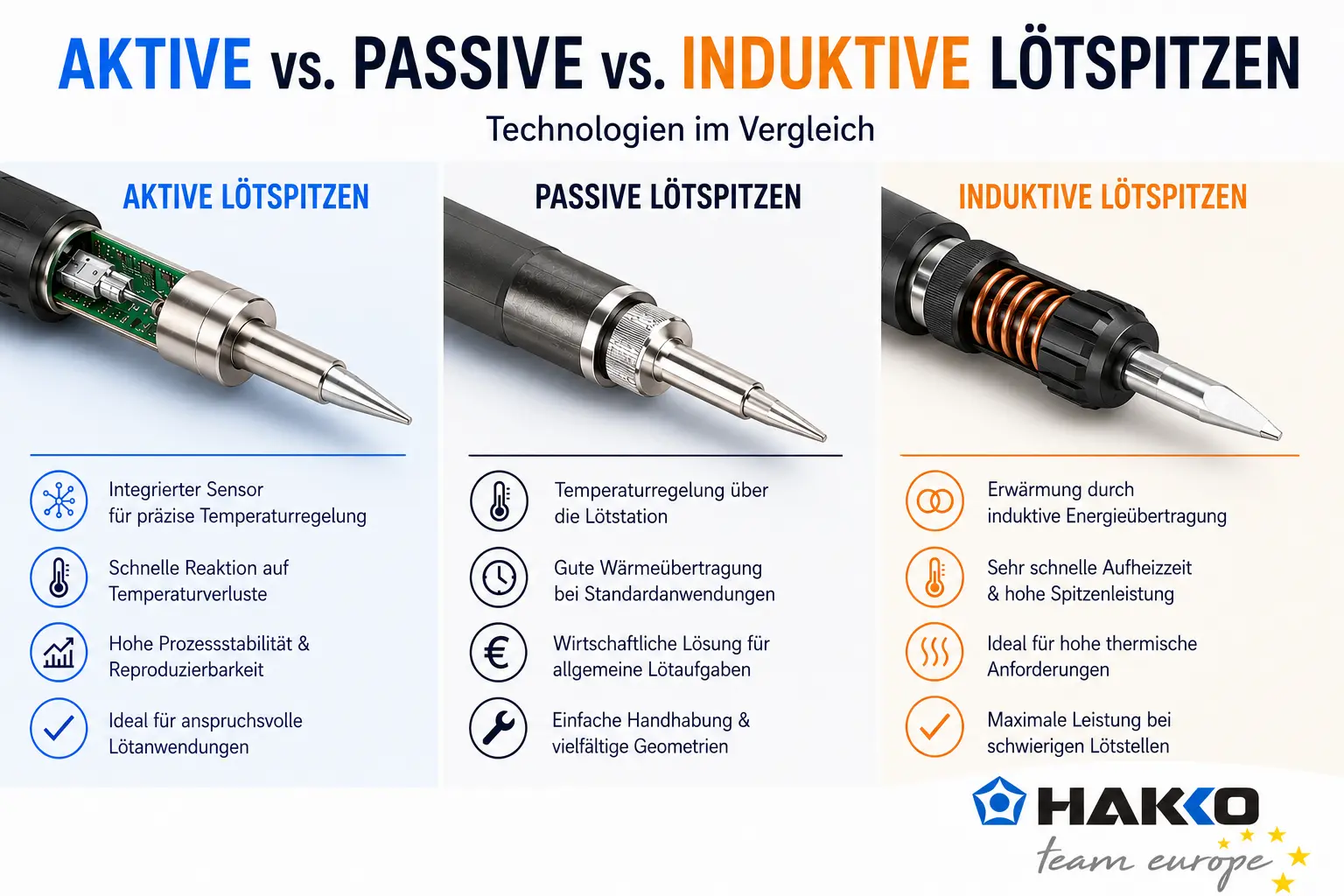
Generally speaking, there are three types of technology: passive soldering tips, active soldering tips, and inductive systems.
Passive Soldering Tips: The Classic Design
In passive soldering tip systems, the heating element and temperature sensor are not located directly in the soldering tip, but rather in the soldering iron or handpiece. The heat is first generated and then transferred to the tip.
This concept has proven itself over many years in electronics manufacturing and is still used today in numerous applications.
The drawback lies in the system's thermal inertia. There is a certain delay between the temperature measurement and the actual temperature at the solder joint. This can lead to temperature fluctuations, particularly in components with high thermal mass or under varying load conditions.
For simple soldering tasks and applications with less demanding requirements, passive systems remain a cost-effective solution.
Active Soldering Tips: Heating Element and Sensor Located Directly in the Tip
Active soldering tips take a different approach. In this design, the heating element and temperature sensor are located directly inside the soldering tip.
This allows the temperature to be measured and controlled directly where the heat is actually transferred. The control system responds significantly faster to load changes and temperature losses.
This offers significant advantages, particularly for modern electronic assemblies:
- rapid temperature recovery after contact with the solder joint
- high temperature stability during the process
- precise heat transfer
- lower thermal load on the assembly
- shorter contact times
Active soldering tips ensure high process reliability and reproducible results, particularly in SMD applications, microelectronics, and rework processes.
The Hakko portfolio offers a variety of soldering tip technologies and tip series for different applications. Systems such as the HAKKO FX-971 and FX-972 use active soldering tips, in which the heating element and sensor are integrated directly into the tip. Depending on the handpiece and application, different types of soldering tips can be used to optimally tailor heat transfer, contact area, and accessibility to the respective soldering process.
Inductive soldering tips. Heating via high-frequency technology
Inductive systems use a different physical principle. Heat is generated directly in the soldering tip through electromagnetic induction.
One example of this technology is the HAKKO FX-100, which uses inductive heating and is designed for rapid energy transfer during the soldering process.
The greatest advantage of inductive systems is their very rapid heating and direct heat input. At the same time, these systems have a high power density.
However, the temperature control system is designed differently from that used in active soldering tips. Instead of traditional sensor-based control, the temperature is regulated based on the properties of the tip being used.
In practice, inductive systems offer high performance but often require careful matching of the application, soldering tip, and process requirements.
Active vs. Passive Soldering Tips: The Key Differences
The main difference between active and passive systems lies in the position of the heating element and the temperature sensor.
In passive systems, the temperature is measured at a distance from the actual solder joint. This results in longer response times to temperature changes.
Active soldering tips measure the temperature directly at the tip and can compensate for load changes much more quickly. This improves temperature stability and reduces the risk of underheating or overheating.
Active technology offers significant advantages in terms of process control and reproducibility, particularly in applications involving high thermal mass, ground planes, or sensitive SMD components.
What technology is suitable for rework and modern electronics manufacturing?
There is no one-size-fits-all answer, as the requirements vary depending on the application.
Passive systems are suitable for standard applications with lower requirements for dynamics and temperature stability.
Inductive systems offer high power density and very fast heating times.
Active soldering tips combine rapid temperature regulation with a high degree of process control and have become particularly well-established in demanding applications in electronics manufacturing.
These include, among others:
- rework of assemblies
- SMD soldering
- microelectronics
- soldering on ground planes
- applications with varying thermal loads