
Why the soldering application is crucial when selecting a soldering tip
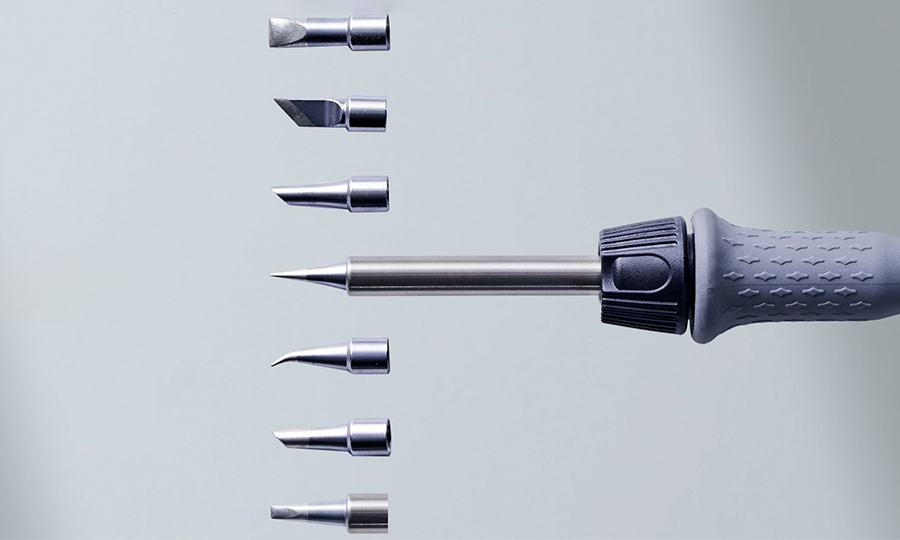
When soldering by hand, it is not only the set temperature that determines the result. The right soldering tip for the respective application is just as important. Its geometry determines how well the heat is transferred, how securely the solder joint can be reached and how stable the process remains.
Particularly in electronics production, rework work and microelectronics, it has been shown that a soldering tip that is too small or unsuitable prolongs the process, increases the thermal load and can lead to insufficient wetting. The right choice of soldering tip is therefore a key factor for reproducible soldering results.
Manual soldering for fine structures and microelectronics
When soldering manually in microelectronics, precise heat transfer and good accessibility to the solder joint are particularly important. The choice of soldering tip has a direct influence on process stability, especially with fine pads, small SMD components or narrow conductor spacing.
Slim or conical geometries are suitable for fine soldering work, as they enable precise work on small contact surfaces. In practice, however, it has been shown that soldering tips that are too small often lead to unstable heat input. Although the geometry is very precise, the heat transferred is often insufficient for certain applications. This results in longer contact times and increased thermal stress on sensitive components.
For micro soldering work, HAKKO offers coordinated soldering irons and matching soldering tip series with a large selection of different geometries for a wide range of applications in electronics production. In combination with the soldering stations of the FX-97 series, precise and reproducible processes can be implemented in daily use.
The HAKKO FX-9703 micro soldering iron, for example, is particularly suitable for precise work in microelectronics. In combination with the HAKKO T50 soldering tips, a wide selection of geometries is available for fine and controlled soldering work.
Rework on larger pads and ground surfaces
When manually soldering and reworking larger pads, connectors or ground planes, stable heat transfer is crucial. With ground planes in particular, it quickly becomes apparent how strongly the choice of soldering tip influences the process.
If the contact area between the soldering tip and the solder joint is too small, the temperature at the tip drops. The solder flows with a delay, the wetting becomes unstable and the contact time is extended.
Wider geometries or chisel tips are suitable for these types of applications, as they can transfer more heat in a shorter time. This reduces the thermal load on the PCB and component and supports reproducible soldering results.
HAKKO offers a large selection of coordinated soldering tip geometries for different rework applications in electronics production. The HAKKO FX-9701 soldering iron in combination with the HAKKO T39 soldering tips, for example, is suitable for power-intensive applications.
Selecting the correct soldering tip shape
The choice of soldering tip should always be based on the specific soldering point. The component geometry, thermal mass, accessibility and desired process time are decisive.
The following applies in practice:
- Fine pads and narrow gaps require precise geometries with good accessibility.
- Standard solder joints often benefit from chisel tips with a stable contact surface.
- Ground surfaces and thermally demanding components require larger contact surfaces for rapid heat input.
Rework processes should be designed for short, controlled contact times.
Stable soldering results thanks to coordinated tool combination
A suitable soldering tip only reaches its full potential in combination with the right soldering station and the right soldering iron. Depending on the application, from fine micro-soldering work to thermally demanding rework processes, the requirements for heat transfer and performance differ significantly.
HAKKO offers coordinated systems consisting of soldering stations, soldering irons and soldering tip series for various applications in electronics production.
This makes the selection of the soldering tip an important factor for stable and reproducible soldering results in the manual soldering process.