
Why manual soldering often causes quality problems
In practice, fluctuating soldering results are often attributed to temperature or power. In reality, however, the cause is often an unsuitable soldering tip.
A correctly set temperature alone is not enough, especially for rework applications or work in microelectronics. The decisive factor is how efficiently the heat is transferred to the solder joint.
If the geometry of the soldering tip is not matched to the component, contact surface and thermal mass, typical error patterns occur:
- Poor wetting
- Temperature loss at the tip
- Unnecessarily long contact times
These effects lead to fluctuating quality and increase the amount of rework required in production.
Poor wetting with large mass areas
Insufficient wetting often occurs particularly with copper surfaces or large-area ground surfaces. Although the temperature is set correctly, the solder only flows with a delay or is distributed unevenly.
This is usually caused by the contact area between the soldering tip and the solder joint being too small. As a result, the required energy cannot be transferred quickly enough and the tip temperature drops during the process.
In day-to-day production, this is often reflected in longer heating times, unstable solder joints and increased time required for rework processes.
The importance of the right combination of soldering tip and heat transfer becomes particularly clear with high-mass assemblies.
Local overheating due to long contact times
If the heat cannot be introduced efficiently, this is often compensated for by prolonged heating. This significantly increases the thermal load on individual areas.
In microelectronics in particular, this increases the risk of:
- Damaged pads
- Thermally stressed components
- Uneven heating of the assembly
A suitably selected soldering tip reduces the necessary contact time and ensures that the heat is applied in a controlled manner.
Extended process times as a typical practical problem
Soldering tips that are not optimally matched not only have an impact on quality, but also directly on efficiency.
If a solder joint has to be heated or reworked several times, the cycle times are noticeably longer. Particularly in series production, these additional seconds quickly add up to a significant loss of productivity.
In practice, this has been shown time and again:
It is not higher temperatures that improve the process, but stable heat transfer with the shortest possible contact time.
Which soldering tip shape is suitable for which application
Different geometries are useful depending on the application.
Conical tips with high precision are suitable for fine work in microelectronics. For larger copper surfaces or high-mass contact surfaces, on the other hand, larger geometries ensure a more stable heat input.
The decisive factor is always the interaction between the peak temperature, the contact surface and the thermal mass of the solder joint.
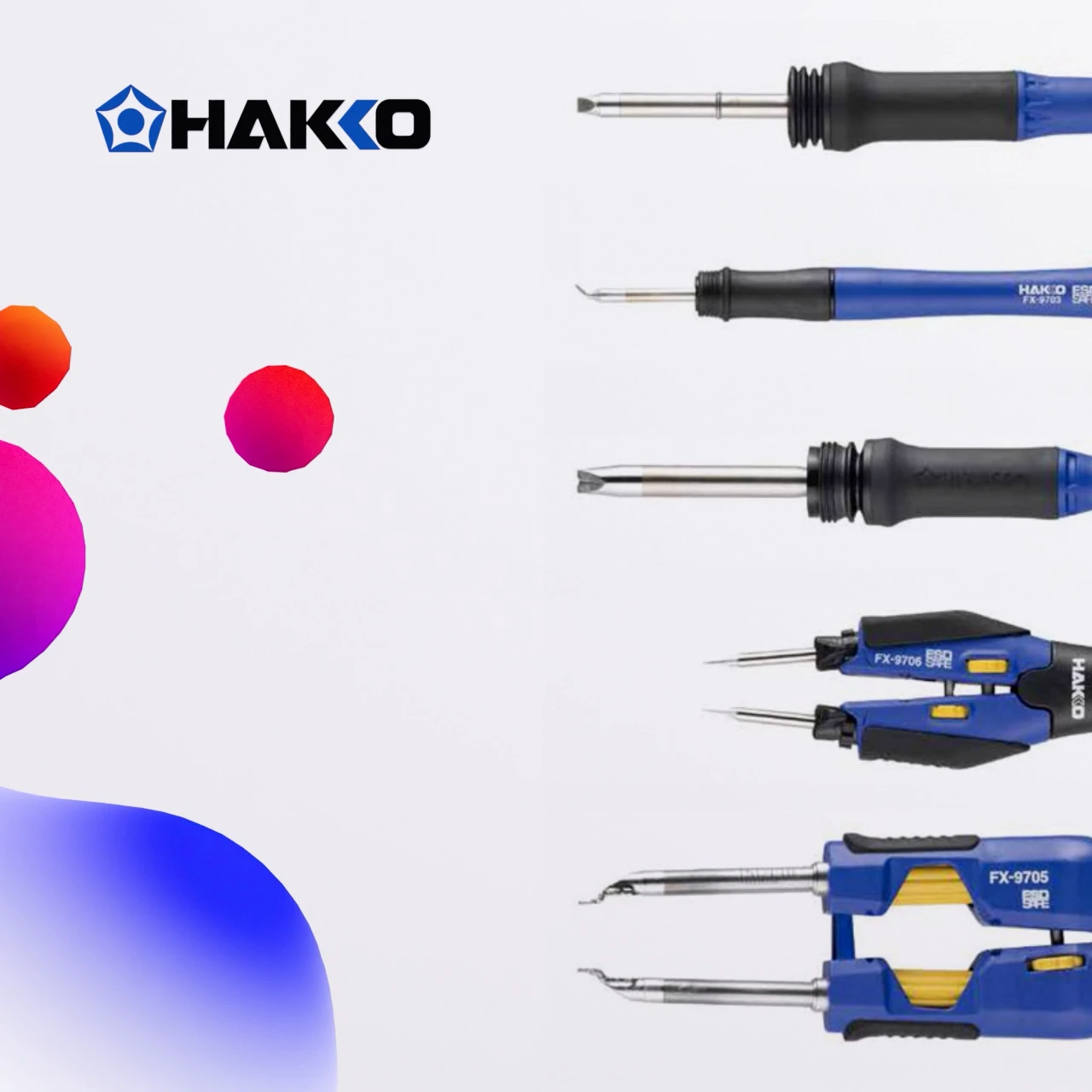
The large selection of HAKKO soldering tips enables specific adaptation to different applications in electronics production.
Stable soldering processes start with the right choice of tools
Many of the main errors in manual soldering are not caused by the operator, but by tools that are not optimally adjusted.
If you specifically match the soldering tip, contact surface and thermal requirements, you can
- Reduce wetting problems
- Shorten process times
- Minimize thermal loads
- Achieve reproducible results
Especially in rework and microelectronics work, it becomes clear how crucial the right soldering tip is for a stable process.