Home page » Blog » The Right Technology for SMD Rework in High-Component-Density Applications
FAQs
What is the difference between the FX-972 and FX-973 when it comes to rework?
Both stations support the same range of soldering and tweezers handpieces. The FX-973 also features a third port and an integrated vacuum pump for the FR-4103 THT desoldering tool.
When is preheating recommended for SMD rework?
Preheating can be helpful for multilayer or copper-rich printed circuit boards if the assembly dissipates a significant amount of heat from the actual rework area. This means that the required temperature rise does not have to be generated solely locally by the rework tool.
What are the differences between the HAKKO FR-850, FR-810B, and FR-811?
The FR-850 is designed for precise micro-hot-air applications involving very small SMD components. The FR-810B and FR-811 offer significantly higher heating power and airflow for larger or more thermally demanding rework tasks. The FR-811 complements this approach with more extensive process control and monitoring capabilities.
When is it advisable to use hot air for SMD rework?
Hot air is particularly suitable for components where multiple solder joints must be melted simultaneously or where individual connections cannot be reached effectively with a soldering tip. These include, for example, QFP or BGA applications.
Which rework technique is suitable for small SMD components?
That depends on the component geometry and accessibility. Small two-pin components, for example, can be worked on with micro soldering tweezers. For very small or closely spaced components, precise micro hot air, such as that provided by the HAKKO FR-850, may be more suitable.
The Right Technology for SMD Rework in High-Component-Density Applications
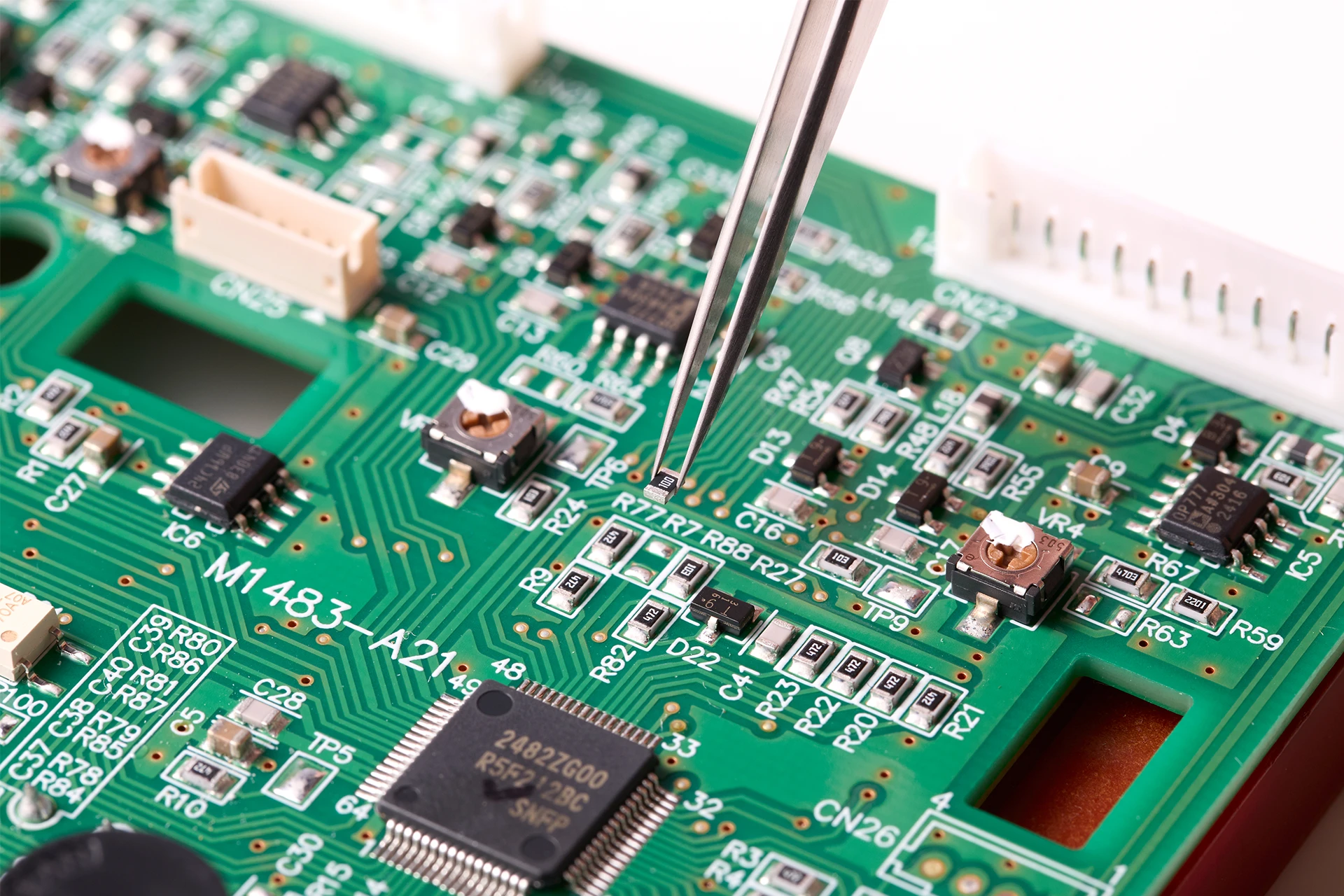
Electronic assemblies are becoming more compact, components are getting smaller, and the spacing between components is decreasing. For SMD rework, this means that not every component can be safely removed or reworked using the same method.
Depending on the package type, accessibility, and heat requirements, a soldering tip, soldering tweezers, or hot air may be the more suitable solution. Therefore, the decisive factor is not the tool itself, but rather the specific rework task.
HAKKO offers a variety of systems for this purpose, ranging from precise micro-hot-air tools for the smallest SMD components to high-performance rework stations for larger components and thermally demanding assemblies.
Why High Component Density Makes SMD Rework More Difficult
The more densely a printed circuit board is populated, the smaller the available working area becomes. At the same time, adjacent components, pads, and traces must be subjected to as little stress as possible from heat or mechanical forces.
Special requirements arise, for example, in the following situations:
very small SMD components
tight spacing between adjacent components
fine-pitch leads
QFP and BGA packages
multilayer printed circuit boards
Assemblies with high heat absorption
Especially when dealing with hidden connections or multiple solder joints that need to be melted simultaneously, a standard soldering tool is often insufficient. In such cases, selecting the appropriate rework method becomes a critical step in the process.
Which Rework Technique Is Best Suited for SMD Applications?
There is no single type of tool that is universally suitable for SMD rework. Different components require different approaches.
Soldering tip for individual solder joints
is suitable for individual, easily accessible connections and solder joints.
Soldering tweezers for small two-pin components
this can be useful for small two-pin components because both pins can be heated at the same time.
Micro-hot air for densely populated areas
offers advantages when very small components in densely populated areas need to be heated as precisely as possible.
Hot-air rework stations for multi-pin SMD components
they are used in particular with multi-pin or surface-mounted components where multiple solder joints must be melted simultaneously.
Rework and Repair
You can find out more about Hakko's rework and repair solutions here.
Precise Hot-Air Rework for Miniaturized SMD Components
For very small SMD components, a precisely focused airflow is more important than the highest possible volume of hot air.
The HAKKO FR-850 is designed as a micro hot-air station for this purpose. It operates with an air flow rate of 1.5 to 5 l/min at temperatures ranging from 50 to 600 °C and is particularly suitable for miniaturized, densely packed components as well as work under a microscope.
This allows heat to be applied in a targeted manner without unnecessarily affecting adjacent components.
Hot-Air Rework for Larger and Thermally Demanding SMD Components
Larger SMD components and thermally demanding assemblies require a more powerful hot-air solution.
The HAKKO FR-810B offers 1,200 W, a temperature range of 50 to 600 °C, an air flow rate of up to 115 l/min, and a vacuum lift function. The FR-811 expands on this concept with additional process control options, including temperature profiles, temperature measurement, and the integration of a bottom heater.
Both systems can be handheld and, if necessary, used with circuit board holders or tripod mounts.
Controlled SMD Rework
Learn more about controlled SMD rework with the HAKKO FR-811 here.
Contact-Based Rework Using a Soldering Tip and Micro-Tweezers
Not every SMD rework task requires hot air. For individual, easily accessible solder joints, a properly sized soldering tip may be the simpler solution. The key factor here is ensuring a sufficient contact area for reliable heat transfer.
For very small two-pin components, for example, the HAKKO FX-9706 micro soldering tweezers are ideal, as they allow both pins to be heated at the same time.
Soldering tips and tweezers complement hot-air soldering wherever direct contact with the solder joint is possible.
When Preheating Is Recommended for SMD Rework
Multilayer printed circuit boards or large copper areas can draw a significant amount of heat away from the rework site. Preheating can help reduce the temperature rise required locally.
The HAKKO FR-830, with a temperature range of 150 to 300 °C, is suitable for general applications. Alternatively, the C5023 underheater with carbon heating elements and two heating zones can be used in the FR-811 system.
Whether preheating is advisable depends on the PCB design, heat requirements, and permissible temperature load.
FX-972 and FX-973 for Flexible Rework Workstations
The FX-972 and FX-973 support the same range of handpieces, including standard, micro, and N₂ soldering irons, as well as SMD and micro soldering tweezers.
The FX-972 has two ports. The FX-973 has three ports and also features a built-in vacuum pump for the FR-4103 THT desoldering tool.
This makes the FX-973 particularly useful when both SMD rework and the desoldering of THT components need to be performed at the same workstation.
From the Assembly to the Right HAKKO Rework Solution
Rework Task
Possible HAKKO Approach
Individual accessible solder joints
soldering tip
Small two-pin SMD components
Micro soldering tweezers
Very small, closely spaced SMDs
FR-850 micro hot air
Larger multipole SMD components
FR-810B or FR-811
Reproducible hot-air processes
FR-811
Assemblies with high heat absorption
additional preheating
SMD and THT rework at the same workstation
FX-973
The key, therefore, is not to provide as many tools as possible at a workstation. Rather, the rework technique must be suited to the component geometry, accessibility, thermal behavior of the assembly, and the desired process control.
The Right Rework Solution
We'd be happy to advise you on selecting the right Hakko tools for your rework soldering tasks.