
FAQs

Once all solder joints have completely melted, the component can be lifted using the integrated vacuum pipette and a suitable suction cup. This requires a suitable setup for vacuum pickup. When used correctly, this reduces the risk of damaging solder pads or circuit traces by forcibly pulling them off.

Preheating can be particularly useful for larger or thermally massive printed circuit boards. Preheating the assembly can reduce the temperature difference that must subsequently be introduced from above using hot air.

The hot air temperature of the FR-811 can be adjusted from 50 to 600 °C. The air flow rate can be adjusted between 5 and 115 l/min. The actual air flow may vary depending on the nozzle geometry used.

The FR-811 is designed for professional SMD rework tasks. Among other things, it is suitable for assemblies with high component density or higher thermal requirements, as well as for components where multiple solder joints must be heated simultaneously with hot air.

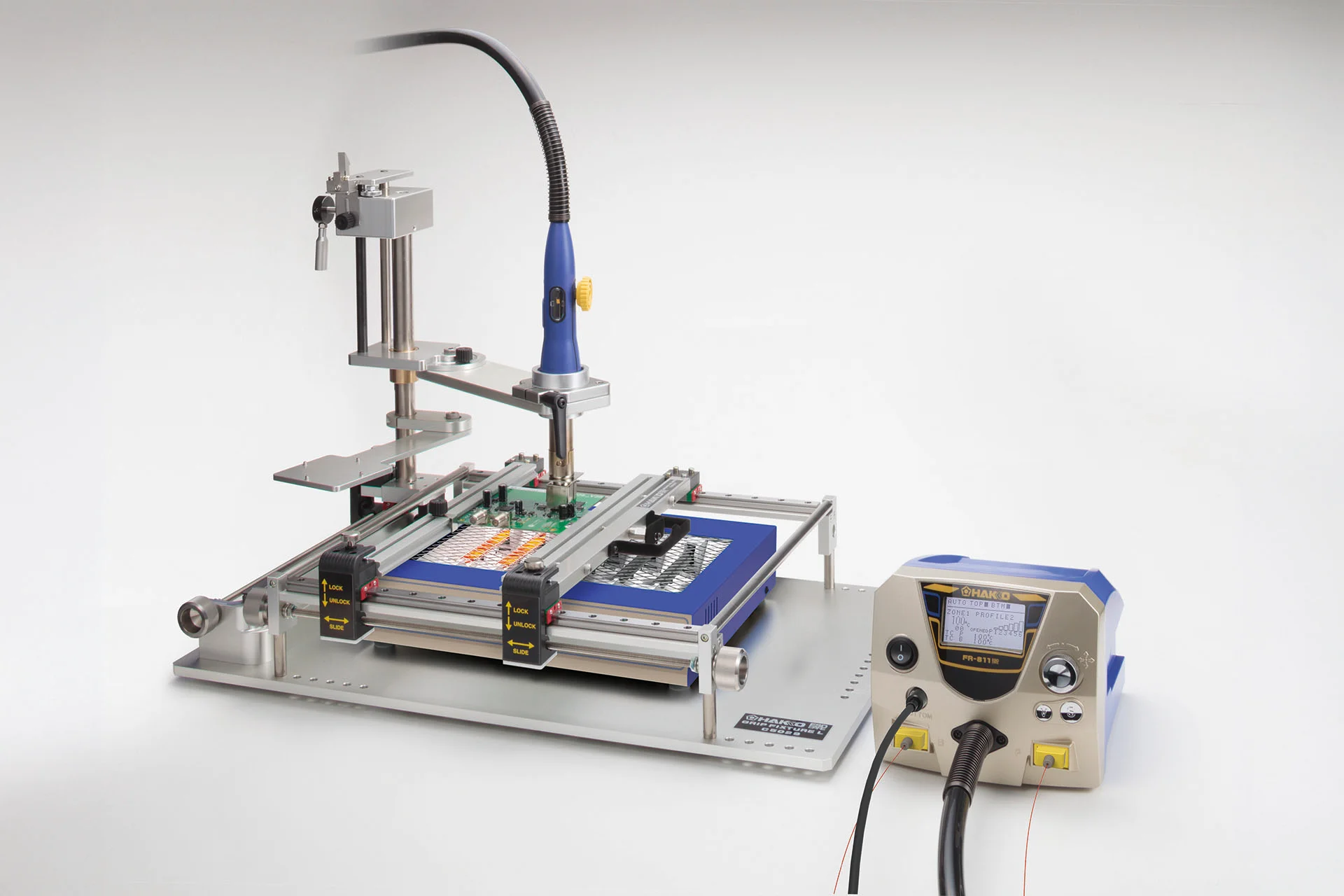
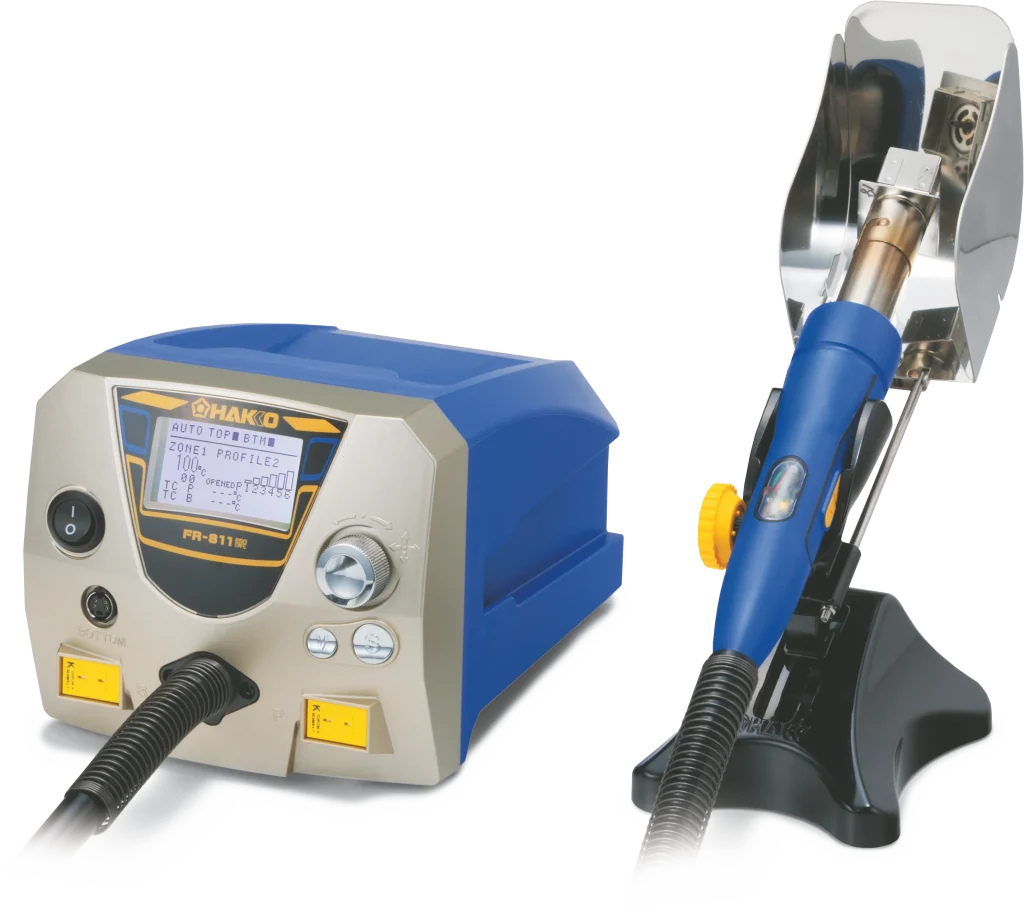
HAKKO FR-811 for controlled SMD rework with hot air

Electronic assemblies are becoming more densely populated, more thermally demanding, and often more valuable. If a single surface-mount device (SMD) needs to be replaced, it is therefore not enough to simply remelt its solder joints. The required heat must be directed to the correct location as precisely as possible. At the same time, the printed circuit board, solder pads, and adjacent components should be subjected to as little additional stress as possible.

The HAKKO FR-811 was developed specifically for tasks like these. This hot-air rework station has been on the market for years and remains part of HAKKO’s current product lineup. Rather than focusing on the promise of a new product, the emphasis is on a technical concept that has been established over many years. Powerful hot air, temperature profiles, temperature measurement, optional bottom heating, and controlled component removal all work together to tackle demanding rework tasks.

Why Controlled Rework Is Important for Complex Assemblies

Components placed close together and larger copper areas can make rework more difficult. Added to this are components that must absorb a lot of heat before they reach the required temperature. On the one hand, sufficient energy must reach the solder joint to reliably melt the solder; on the other hand, the thermal load on the assembly should not be unnecessarily increased.

What matters is the interplay between hot air temperature, air flow rate (air volume per minute), nozzle shape, exposure time and, if necessary, preheating of the printed circuit board. The HAKKO FR-811 provides a power consumption of 1,200 W at 230 V, a hot air temperature ranging from 50 to 600 °C, and an adjustable air flow rate of 5 to 115 l/min. The actual airflow achievable may vary depending on the nozzle used.

Hakko Rework Station
Learn more about the Hakko FR-811 rework station here:

Using Hot Air Strategically in SMD Rework

Hot air is particularly well-suited for SMD components where multiple solder joints need to be heated simultaneously or where individual terminals cannot be easily reached with a traditional soldering tip.

The nozzle plays an important role here. It determines how the hot air is directed onto the component and the circuit board. HAKKO offers a variety of N51 nozzles for the FR-811, including numerous variants for different sizes of BGA components. On these BGA nozzles, air slots on the top promote air circulation inside the nozzle, thereby supporting more even heating.

The combination of high heating power and high airflow can be particularly advantageous for assemblies with high heat requirements.  In a comparison documented by HAKKO, solder joints on a ceramic circuit board made of FR-810B and FR-811, respectively, were heated to 200 °C within 48 seconds under the specified conditions. A conventional comparison system took 177 seconds. Since the temperature and airflow settings differed, this value should not be interpreted as a general comparison of speed. However, it demonstrates the influence of heating power and airflow on the heating time.

Please contact us
We would be happy to provide you with personalized advice on your rework process and the selection of the right nozzles.

Temperature Profiles Instead of Relying on Instinct

Especially for recurring rework tasks, it makes sense to save and reuse the hot air temperature, air flow rate, and process time. With the HAKKO FR-811, you can create temperature profiles with up to six process phases. For each phase, the hot air temperature, air flow rate, and duration can be set and saved.

In combination with an optional bottom heater, this allows different heating phases to be coordinated. A supplied thermocouple sensor also allows temperature to be measured directly on the component or on the printed circuit board. Temperature curves can be displayed in real time via the USB connection and the included PC software. The settings and measurement data can be saved as a CSV file for further analysis.

What matters, therefore, is not only the temperature set at the station, but also the temperature actually reached at the measurement point.

When Is Bottom Heat Useful During Rework?

For larger circuit boards or assemblies with high thermal capacity, it may be advisable to preheat the circuit board from below as well.

The optional bottom heater on the HAKKO FR-811 uses carbon heating elements and features two separate heating zones. Its settings and operating parameters can be integrated into the rework process.


Preheating ensures that the hot air from above does not have to overcome the entire required temperature difference on its own. However, whether and to what extent bottom heat should be used depends on the PCB design, the components, the solder alloy, and the permissible temperature limits.

Controlled rework of high-quality assemblies

The more complex an electronic assembly is, the higher its material and manufacturing value may be. Therefore, a single defective or damaged component does not necessarily mean that the entire assembly must be discarded.

This requires a controlled rework process. For example, when removing the component, care should be taken to avoid applying mechanical forces to solder joints that have not yet completely melted.

Once all solder joints have completely melted, the component can be lifted using the integrated vacuum pipette and a suitable suction cup. The lift indicator helps the user monitor the process even when the component and solder joint are partially obscured by the nozzle. This reduces the risk of damaging pads or traces by forcibly removing the component.

Especially when it comes to high-quality assemblies, professional rework offers both technical and economic benefits. The goal is to replace the defective component and restore the assembly's functionality.

A proven rework concept for today's requirements

The FR-811 has been a market staple for years and has proven that its technical design is effective for demanding SMD rework tasks. Especially in light of densely populated, thermally challenging, and high-quality assemblies, this approach is more relevant today than ever.

Its strength lies not in a single feature, but in the interaction of several proven functions. Controlled hot air, temperature profiles, temperature measurement, optional bottom heat, and vacuum lift support reproducible process control and the gentlest possible component removal.

The appropriate settings and system configuration continue to depend on the specific assembly, its geometry, thermal mass, and permissible temperature load.