Home page » Blog » Spot Soldering vs. Drag Soldering in Robotic Soldering
FAQs
What accessory solutions does Hakko offer for robotic soldering?
Among other products, Hakko offers slide units, tip cleaners, temperature probes, N2 adapters, and various TX1 and TX2 soldering tips. These components support stable, reproducible spot and drag soldering processes.
Why is solder wire feeding important in robotic soldering?
Precise solder wire feeding ensures that the correct amount of solder is delivered to the joint in a controlled manner. This promotes stable solder joints and reproducible results in the automated soldering process.
Which Hakko solution supports automated soldering?
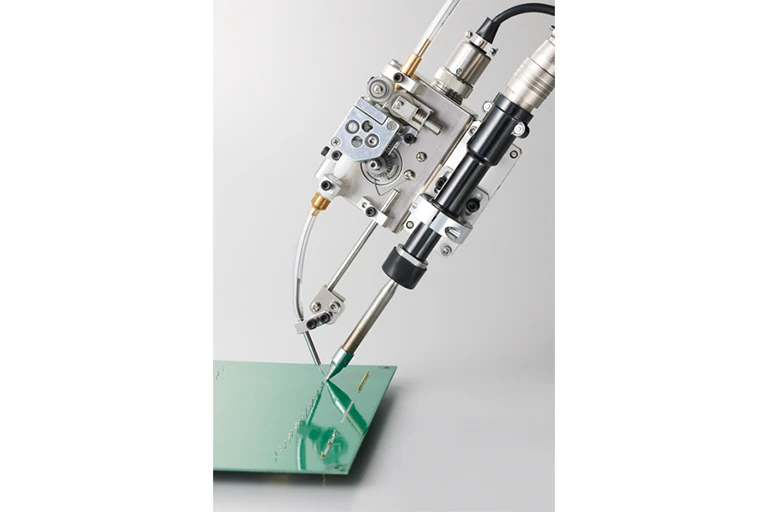
With the FU-500 and FU-601, Hakko offers an auto-soldering system for automated soldering processes. The FU-500 handles the precise feeding of solder wire, while the FU-601 serves as a high-performance soldering unit for robotic soldering.
What role does the soldering tip play in drag soldering?
In drag soldering, the soldering tip must be suited to the joint geometry, movement, and heat requirements. The correct tip shape promotes uniform heat transfer and consistent wetting along the solder joints.
When is drag soldering a good choice?
Drag soldering is useful for terminal blocks, connector strips, or components with evenly spaced pins. This method can efficiently process multiple solder joints in a single motion.
When is spot soldering appropriate in robotic soldering?
Spot soldering is suitable for individual solder joints, various pad geometries, selective soldering tasks, and assemblies where heat must be applied with particular precision.
What is the difference between spot soldering and drag soldering in robotic soldering?
In spot soldering, each solder joint is processed individually. In drag soldering, the soldering tip is guided along several connections, allowing multiple solder joints to be soldered in a single motion.
Spot Soldering vs. Drag Soldering in Robotic Soldering
In robotic soldering, the soldering task determines whether spot soldering or continuous soldering is the better method. Spot soldering is particularly suitable for individual, targeted, or differently configured solder joints. Continuous soldering shows its strengths when multiple connections can be soldered in a uniform motion.
Component geometry, PCB layout, accessibility, cycle time, and the desired soldering quality are key factors in the selection process. With the Hakko FU-500/FU-601 robotic soldering unit, automated soldering processes can be tailored to these requirements, from precise solder wire feeding to the appropriate soldering tip and complementary accessories.
What are the advantages of spot soldering in robotic soldering?
In spot soldering, each solder joint is approached individually and soldered with precision. This allows for very precise control of the amount of solder, contact time, and heat input. The process is particularly well-suited for individual connections, selective solder joints, or assemblies with different pad geometries.
Typical benefits include:
a high degree of control over every single solder joint
Precise dosing of solder and heat
well-suited for varying solder joint geometries
targeted treatment of sensitive areas
high reproducibility in selective soldering applications
For more information on the Hakko robotic soldering unit, click here:
What are the advantages of drag soldering in robotic soldering?
In drag soldering, the soldering tip is guided along several terminals. This allows multiple solder joints to be processed in a single, defined motion. The process is particularly well-suited for connector strips, rows of terminals, or components with evenly spaced pins.
Typical benefits include:
efficient processing of multiple connections
shorter processing times for suitable geometries
uniform soldering motion along a row of pins
well-suited for recurring soldering tasks
consistent results with a properly adjusted soldering tip and wire feed
Spot Soldering or Drag Soldering: Which Method Is Better?
In robotic soldering, the soldering task determines whether spot soldering or drag soldering is the better method. Spot soldering is often the right choice when individual solder joints need to be processed with precision. Drag soldering is useful when multiple connections can be soldered in a defined motion.
The most important factors are:
number and arrangement of solder joints
component shape and pad geometry
PCB design
amount of heat required
desired cycle time
accessibility of the solder joint
requirements for repeatability and process reliability
In many applications, a combination of both methods may also be appropriate. Individual solder joints are processed on a case-by-case basis, while suitable rows of connections are soldered using the drag soldering method.
Hakko FU-500: Precise Solder Wire Feeder for Automated Processes
The Hakko FU-500 handles the solder wire feed in the automated soldering process. It ensures that the solder wire is fed to the solder joint in a controlled and repeatable manner. This is important for both spot soldering and drag soldering, because the amount of solder must be appropriate for the respective solder joint and the sequence of movements.
For automated use, the FU-500 offers wire feed monitoring functions. It can detect issues such as a jammed wire, slippage, or the end of the wire spool. This allows for faster identification of interruptions in the process and reduces errors caused by insufficient solder feed.
In addition, the FU-500 supports measures to reduce solder balls. This is particularly important in automated soldering processes, as splatter or residue can affect the assembly and adjacent areas.
Hakko FU-601: High-Performance Soldering Unit for Robotic Soldering
The Hakko FU-601 is the soldering unit of the robotic soldering system and provides the power required for automated soldering processes. It supports applications in which heat must be transferred to the solder joint precisely, quickly, and reliably.
This is important in spot soldering because each solder joint is approached individually, and the heat input must be tailored to the specific shape of the connection. In drag soldering, it is essential that the soldering tip can move evenly along the row of connections and that heat transfer is maintained throughout the movement.
Depending on the system configuration and accessibility, different types of soldering irons can be used, such as straight or angled models. This allows the robotic soldering unit to be better adapted to the installation space, direction of movement, and soldering location.
Learn more about the Hakko FU-500/FU-601 robotic soldering unit here: