FAQs

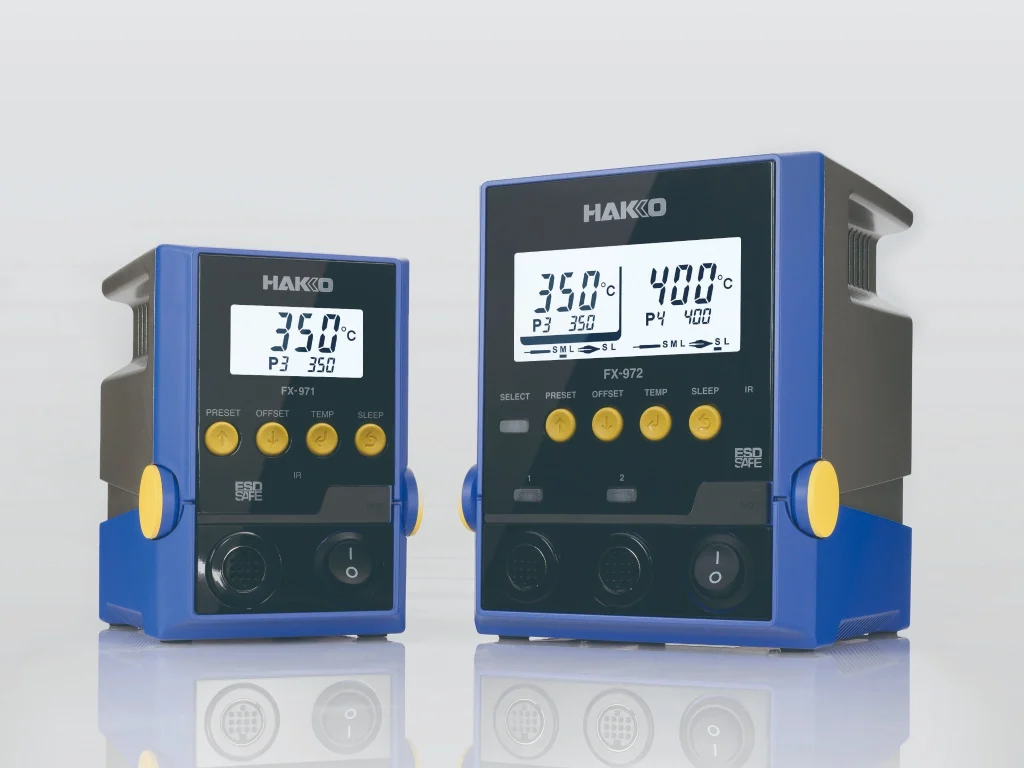
The FX-972 is designed for flexible workstations with two connected tools and supports standard, micro, N₂, and high-power soldering irons as well as soldering tweezers. If vacuum-assisted THT desoldering is also required, the FX-973 expands this concept to include the FR-4103 desoldering tool.
Traceability is particularly important when process data needs to be documented, quality requirements need to be verifiably met, or soldering processes need to be evaluated at a later date. The FX-97X systems support this by recording temperature data and correction values via a PC connection.

The soldering tip determines the contact area and heat transfer to the solder joint. An unsuitable geometry can result in insufficient heat transfer, even if the station has sufficient power.

Not necessarily. Two ports make sense if you regularly need two different handpieces. For a workstation with only one tool, a single-port station like the HAKKO FX-971 may be the better solution.

That depends on the thermal mass of the solder joint. Small electronic solder joints require less power than large connections, shielding, or copper-rich circuit boards. The key factor is that the station must be able to compensate for the heat loss at the solder joint quickly enough.

Which features of a soldering station are really important?

More power, more ports, more customization options. Modern soldering stations offer a wide range of features. But not all of them are equally relevant for every application.

The requirements for a workstation used for individual standard solder joints differ from those for fine SMD work, large terminals, or manufacturing processes that require documentation. When selecting a soldering station, therefore, the decision should not be based on the longest list of features, but rather on the specific soldering task at hand.

Our HAKKO portfolio ranges from compact single-port stations to flexible multi-channel systems and high-performance solutions with advanced features for process control and documentation. What matters most is which features actually support the specific process.

How much power does a soldering station need?

Wattage is an important specification, but on its own, it says little about how well a soldering station is suited to a particular application.

The key factor is whether sufficient heat can be transferred to the solder joint and quickly replenished in the event of heat loss. Small SMD solder joints require significantly less thermal power than large connections, shielding, or copper-rich multilayer assemblies.

For many typical hand-soldering tasks, for example, the HAKKO FX-971 with 100 W offers a compact solution. For larger thermal masses, more powerful handpieces and systems are available. The FX-805, equipped with a soldering iron delivering up to 400 W, is specifically designed for high-mass solder joints and applications in power electronics.

In practice, therefore, what matters less is the station's wattage alone than whether sufficient heat can be reliably and precisely transferred to the solder joint.

Discover the HAKKO FX-971
Discover the high-performance HAKKO FX-971 soldering station and find the right solution for your soldering tasks.

Why the soldering tip and handpiece are just as important as the soldering station

A high-performance station can only deliver its full benefits if the handpiece and soldering tip are suitable for the solder joint.

Although a tip that is too small offers good accessibility, it may not transfer enough heat. A tip that is too large, on the other hand, may be mechanically or geometrically unsuitable for fine structures. Therefore, the range of available tools and soldering tips is a key selection criterion.

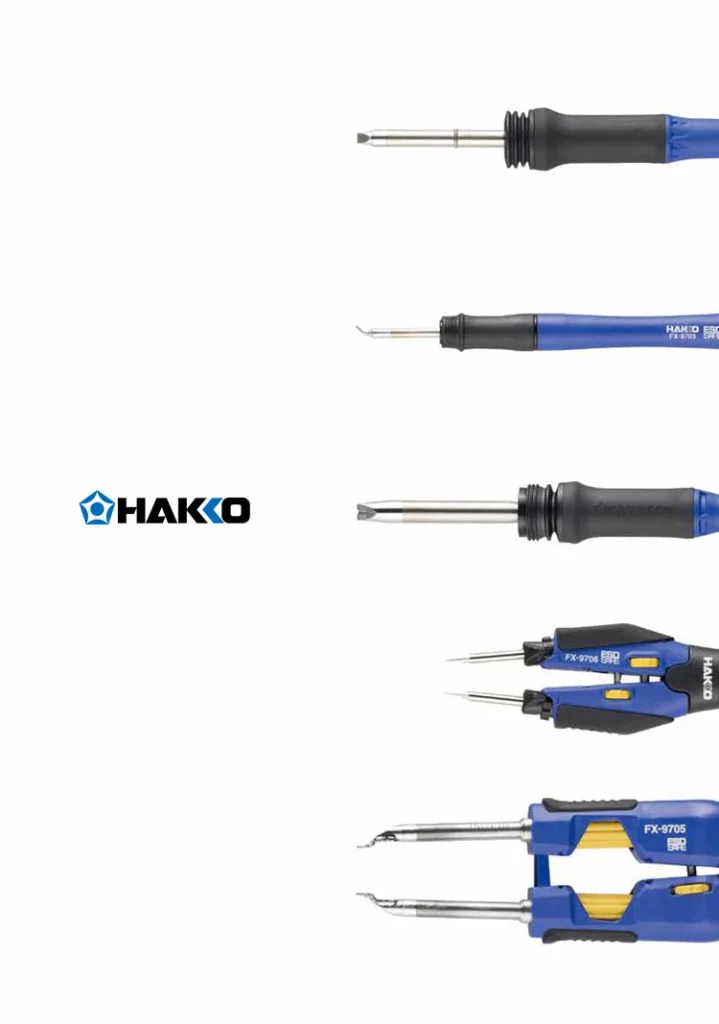
For example, the HAKKO FX-971 can be used with standard, micro, and N₂ handpieces. The FX-972 also supports high-performance soldering irons as well as SMD and micro soldering tweezers. This allows the same workstation to handle a wide variety of soldering tasks.

HAKKO TIP

The soldering station should not only be suitable for today's soldering job, but also support the handpieces and tips that are actually needed.

Learn more about the HAKKO FX-972 here

When are multiple ports useful?

A second or third port is particularly useful when different soldering tools are regularly needed at a workstation.

The HAKKO FX-971 is designed as a single-port station for applications where a single handpiece is sufficient. The FX-972 offers two ports and allows, for example, the use of different soldering or tweezers handpieces.

The FX-973 expands this concept to three ports and adds the vacuum-assisted FR-4103 THT desoldering tool to the range of tools. The vacuum pump required for this is already integrated into the station.

Having multiple ports is therefore particularly useful when different soldering and rework tasks are to be performed regularly at the same workstation.

Learn more about the HAKKO FX-973

How important is precise temperature control?

When soldering, it's not just the set temperature that matters. What really counts is how stable the temperature at the soldering tip remains during the process.

If the tip cools down significantly at a thermally demanding solder joint, the station must provide the necessary additional energy. Rapid temperature control helps minimize temperature fluctuations and ensure a stable soldering process.

For the FX-97X series, HAKKO relies on soldering tip systems with an integrated sensor and rapid power adjustment. In addition to the set target temperature, information on the tip’s sensor temperature can also be displayed.

This allows for more controlled heat transfer to the solder joint and ensures that the process is carried out as uniformly as possible, even under varying thermal conditions.

When are temperature compensation and calibration important?

In professional manufacturing processes, it is often not enough to simply set a temperature value at the station. It is essential to ensure that the actual soldering tip temperature is appropriate for the process.

With the FX-971 and FX-972, readings from compatible HAKKO solder tip thermometers can be transmitted to the station via infrared and used for temperature calibration or correction. This reduces the need for manual data entry and supports a controlled process. This feature is particularly important in environments where workstations are standardized or soldering processes must be regularly monitored.

When are process documentation and traceability important?

In development, repair, or small-batch production, reliable temperature control is often sufficient. In more tightly controlled manufacturing environments, however, process data and traceability can also play an important role.

Among other things, the FX-97X systems allow for the recording of temperature data and correction values via a PC connection. This makes it easier to document relevant process data and analyze it as needed.

Traceability is therefore not required for every workstation. However, in quality-critical applications or those requiring documentation, it can be an important factor in selecting a soldering station.

What are the benefits of Auto-Sleep and automatic shutdown?

A soldering tip does not need to be kept at operating temperature at all times when you are not soldering.

The HAKKO FX-971 and FX-972 are therefore equipped with adjustable auto-sleep and shut-off functions. When the handpiece is not in use, the temperature can be automatically reduced or the station can be shut off.

This doesn't just save energy. Lowering the temperature during longer breaks can also help reduce wear on the soldering tip.

This seemingly minor feature is therefore particularly useful in workplaces where tasks vary.

What role do usability and ergonomics play?

A soldering station should be intuitive to use in everyday work and integrate well into the workspace. Easily readable temperature readings, quickly accessible settings, and ergonomic positioning play an important role in this regard.

With the FX-971 and FX-972, for example, the angle of the station housing or display can be adjusted to suit the specific work situation. The FX-888DX, on the other hand, features particularly simple operation via a rotary pushbutton. With 100 W of power and the T18 soldering tip series, it is suitable for training, development, and general soldering tasks, among other applications.

Which operating functions are useful depends largely on the application. While additional adjustment and documentation options may be important in manufacturing, other applications prioritize fast and straightforward operation.

Which HAKKO soldering station is best suited for which application?

The selection can be narrowed down to a few key requirements:

Application

A particularly important function

Possible HAKKO Solution

General Soldering Tasks, Training, Development

Easy to use and compatible tips

FX-888DX

Professional Individual Workstation

Compact unit, fast temperature response

FX-971

Tool Changes and Rework

Two ports, wide range of handpieces

FX-972

Soldering and THT Desoldering at a Single Workstation

three ports and built-in vacuum technology

FX-973

Large thermal masses and power electronics

high thermal power reserve

FX-805

The right station is therefore determined by the solder joint, thermal requirements, necessary tools, and process requirements—not by having as many features as possible.

Discover HAKKO Soldering Stations
Whether for precision soldering, demanding repairs, or professional, continuous use: Discover the versatile range of HAKKO soldering stations and find the right solution for your needs.

So, which features are really important in a soldering station?

For a reliable soldering process, the most important factors are the features that are best suited to the actual application. For standard solder joints, stable temperature control and the appropriate soldering tip system may be sufficient. For varying SMD, micro, or high-performance tasks, however, it makes sense to have multiple handpieces or ports.

When dealing with large thermal masses, available power becomes a key consideration. In quality-critical manufacturing processes, on the other hand, temperature calibration, process data acquisition, and traceability can be crucial.

Therefore, the best soldering station is not necessarily the one with the most features, but rather the one whose performance, tool design, and process functions are best suited to the specific soldering task.

We'd be happy to advise you in person
Would you like to know which HAKKO soldering station is right for your application? We'd be happy to advise you on choosing a station, handpiece, and soldering tip.