Home page » Blog » When Should You Replace a Soldering Tip? Signs, Causes, and Effects on the Soldering Process
FAQs
Can you keep working with a worn-out soldering tip?
Technically, this is possible; however, it significantly increases the risk of poor wetting, longer process times, and thermal stress on the assembly.
Which HAKKO soldering tip is right for my application?
The right HAKKO soldering tip depends on the component geometry, contact area, and thermal mass. Various geometries and tip series are available for SMD work, rework, or large contact areas. If you’re unsure, you can use the soldering tip finder or ask for advice on the right choice.
How long does a soldering tip last?
Service life depends on temperature, usage, cleaning method, and application. When handled properly, high-quality soldering tips can deliver consistent results over a long period of time.
Why do soldering tips oxidize?
Oxidation occurs as a result of high temperatures and contact with oxygen. It impairs wettability and reduces heat transfer.
How can you tell if a soldering tip is worn out?
Typical signs include poor wetting, longer soldering times, visible wear, and a higher temperature requirement for the same application.
When should you replace a soldering tip?
A soldering tip should be replaced if its wetting ability permanently decreases, its geometry is damaged, or heat transfer significantly deteriorates.
When Should You Replace a Soldering Tip? Signs, Causes, and Effects on the Soldering Process
Why the Condition of the Soldering Tip Affects Soldering Quality
The soldering tip is one of the most heavily used components of a soldering station. Its condition directly affects how efficiently heat is transferred and how consistently soldering processes can be carried out.
As the tip is used over time, its surface and geometry change. As a result, heat can no longer be optimally transferred to the solder joint. This leads to longer contact times, inconsistent soldering results, and increased thermal stress on components and printed circuit boards.
In electronics manufacturing in particular, it is therefore important to detect wear early on and replace the soldering tip at the appropriate time. HAKKO offers a comprehensive portfolio of soldering tips for a wide variety of applications, ranging from fine micro-soldering to thermally demanding rework processes.
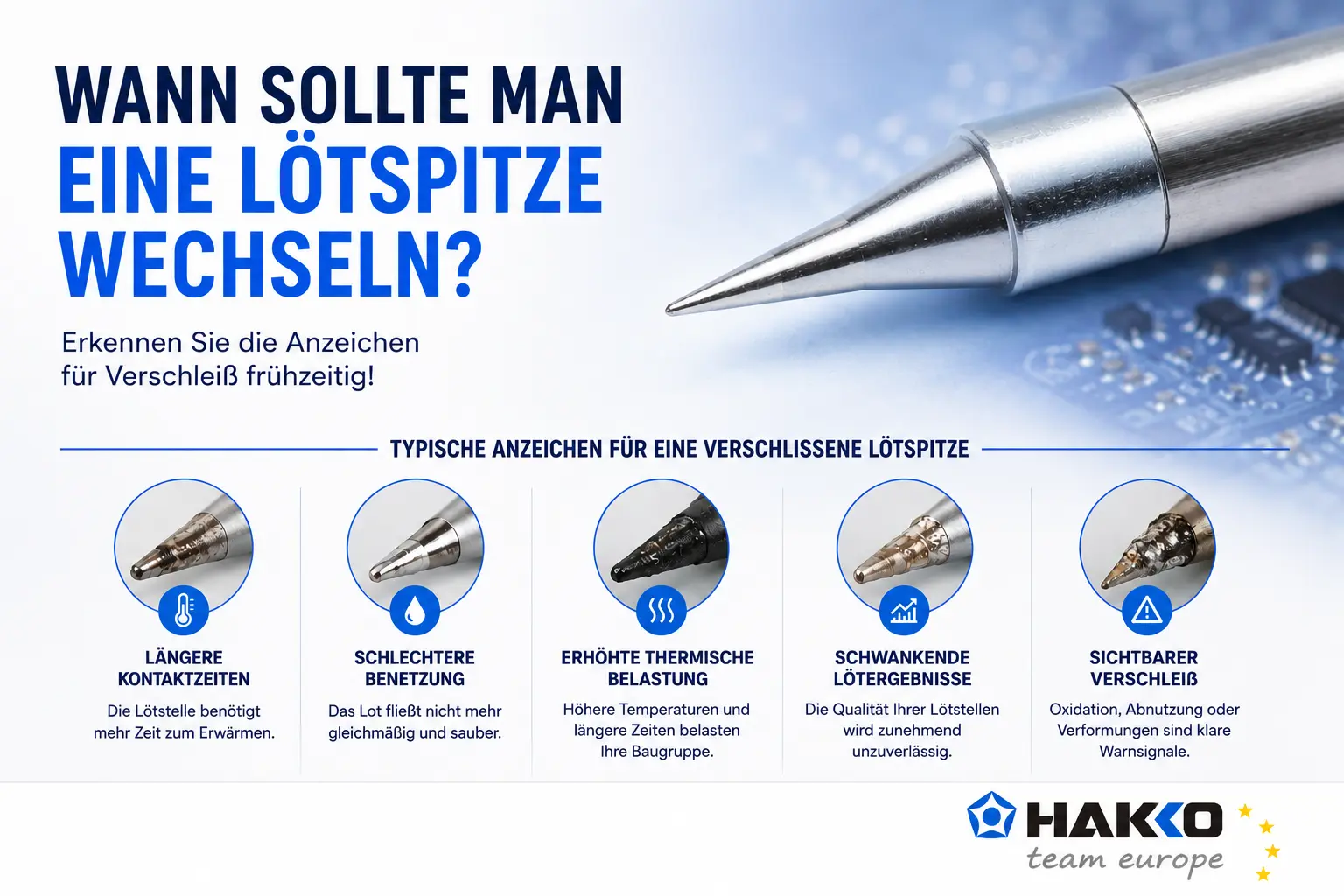
How can you tell if a soldering tip is worn out?
A soldering tip does not have to be completely damaged to negatively affect the process. Even minor changes can significantly impair heat transfer.
Typical signs include:
Solder no longer wets the tip evenly
The solder joint takes longer to form
Higher temperatures are needed than before
The contact time is noticeably longer
The tip shows visible wear or deformation
In practice, the temperature is often raised first to compensate for these effects. However, this increases the thermal load on the assembly, while the actual cause remains unchanged.
Why do soldering tips wear out?
During operation, soldering tips are constantly exposed to high temperatures. At the same time, flux, solder alloys, and mechanical stress act on the surface.
The most common causes include:
Oxidation caused by high temperatures
Mechanical abrasion during cleaning
Chemical exposure from flux residues
Unnecessarily high operating temperatures
Over time, the protective layer on the tip becomes worn away. Wettability decreases, and heat transfer deteriorates.
How does a worn soldering tip affect the soldering process?
Wear usually becomes apparent gradually. The time it takes to establish a stable solder joint increases, and the temperature at the solder joint becomes increasingly unstable.
For the process, this means:
Uneven wetting
Longer soldering times
Greater thermal stress on sensitive components
Inconsistent soldering quality
Increased rework
These effects become quickly apparent, particularly with SMD components, microelectronics, and rework applications.
Find out here how you can avoid mistakes by choosing the right soldering tip:
The tip should be replaced before the soldering quality visibly deteriorates. What matters is not the age of the soldering tip, but its actual condition during the process.
The tip should be replaced if:
Wetting continues to deteriorate
The geometry has changed
Temperature losses occur
Contact time increases significantly
A change is usually more cost-effective than additional rework or process losses.
How can you extend the life of a soldering tip?
Proper handling has a significant impact on service life.
The following measures have proven effective:
Use the lowest temperature at which the process is reliable
Clean the tip regularly
Avoid unnecessary mechanical stress
Select the appropriate geometry for the application
Keep the tip sufficiently tinned
Modern active solder tip systems also support stable temperature control and reduce unnecessary thermal stress.
Why an intact soldering tip is the better investment
Many quality issues are initially attributed to temperature, solder, or process parameters. In practice, however, the cause often lies in a worn or improperly selected soldering tip.
Checking the condition regularly and using the appropriate geometry for each application improves soldering quality, reduces rework, and supports stable processes in electronics manufacturing.
An intact and application-specific HAKKO soldering tip is therefore a key factor in achieving consistent soldering results.
We'd be happy to help you choose the right soldering tip for your specific soldering task.