Home page » Blog » Avoiding Common Mistakes in SMD Soldering
FAQs
Which Hakko tools support SMD rework?
For SMD rework, Hakko offers soldering tweezers, desoldering tools, rework systems and suitable handpieces, depending on the application. These help to remove, replace or rework components in a controlled manner.
When do you need a micro soldering iron for SMD soldering?
A micro soldering iron is useful for very small SMD components, tight pad distances and hard-to-reach solder joints. It allows for precise control of the soldering tip and enables controlled work on densely packed printed circuit boards.
Is a higher temperature always the solution when soldering SMDs?
No. A higher temperature is no substitute for proper heat transfer. The key factors are the soldering tip, the contact area, the power of the soldering iron, the contact time and the PCB design. A temperature that is too high can damage components or pads.
Why is choosing the right soldering tip so important for SMD soldering?
The soldering tip determines how effectively heat is transferred to the solder joint. A tip that is too small may not provide enough energy, whilst a tip that is too large may damage neighbouring components. The key factor is ensuring the correct contact area with the solder joint.
What are the most common mistakes made when soldering SMDs?
Common mistakes in SMD soldering include using an unsuitable soldering tip, misjudging heat transfer, and using inappropriate rework tools. These factors can lead to wetting problems, cold solder joints or damaged pads.
Avoiding Common Mistakes in SMD Soldering
SMD soldering is one of the most demanding manual processes in electronics manufacturing. Small components, tight pad spacing, and delicate printed circuit boards require tools that are precisely suited to the application.
The following are particularly important:
the right SMD soldering station
the right soldering iron
the right soldering tip
stable temperature control
appropriate rework and repair tools
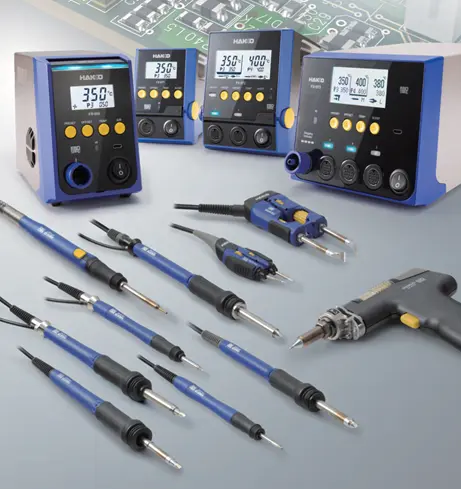
Even minor deviations can affect the quality of the solder joint. Hakko offers a wide range of products for this purpose, including SMD soldering stations, micro soldering irons, high-performance soldering irons, N2 soldering irons, soldering tips, soldering tweezers, and desoldering and rework systems. This allows manual SMD soldering processes to be precisely tailored to the specific application.
Mistake 1: Using the wrong soldering tip
One of the most common mistakes in SMD soldering is choosing the wrong soldering tip. Many users automatically reach for the finest tip because SMD components are small. However, this isn’t always the best solution. A soldering tip that’s too small may not transfer enough heat. This results in longer contact times, poor wetting, or cold solder joints.
It is not just the size of the tip that matters, but also the appropriate contact area with the solder joint. Fine tips are suitable for very small pads and precision work. Chisel tips offer better heat transfer for many standard SMD applications. Beveled tips can be helpful for drag soldering on IC leads. Wider tips are suitable for larger pads or areas with high mass.
Hakko offers a range of soldering tip series designed for different soldering irons. This allows the tip shape to be tailored to component size, pad geometry, and heat requirements. This improves heat transfer and helps ensure reproducible solder joints.
Find out here how you can avoid mistakes by choosing the right soldering tip:
Mistake 2: Temperature and heat transfer are misjudged
In SMD soldering, temperature is often considered the sole factor affecting quality. In practice, however, the actual heat transfer at the solder joint is crucial. Insufficient heat input can lead to wetting problems. Too high a temperature or too long a contact time can damage components, pads, traces, or solder mask.
This is particularly critical for multilayer printed circuit boards, ground planes, shielded components, or components with high heat dissipation. In these cases, a fine soldering iron is often insufficient, even though the set temperature appears to be high. Instead of further increasing the temperature, a better combination of soldering station, handpiece, and soldering tip is usually required.
The Hakko FX-97 family offers flexible options for this purpose. The FX-971 is a compact, base soldering station suitable for precise manual soldering work. The FX-972 is a 2-port station that allows the use of different handpieces. The FX-973 expands the workstation as a 3-port station for particularly versatile requirements.
For fine SMD work, for example, the FX-9703 micro soldering iron is ideal. For larger solder joints or when more heat is required, more powerful Hakko handpieces—such as high-performance soldering irons or N2 soldering irons—may be the better choice. This not only regulates the temperature but also adapts the total heat input to the application.
Mistake 3: Rework is performed using unsuitable tools
SMD soldering work often includes rework, repairs, and component replacement. Errors can occur during rework in particular if components are removed or adjusted using unsuitable tools. Excessive mechanical stress can cause pads to detach. Uneven heating can damage circuit boards or surrounding components.
For two-pin SMD components, soldering tweezers can be useful, as they heat both leads at the same time. For other rework tasks, depending on the component, hot-air systems, desoldering techniques, or special handpieces are used. The key is to apply heat in a controlled manner and remove or rework the component with as little stress as possible.
Hakko offers suitable solutions for SMD rework, desoldering, and repair. When used in combination with the appropriate soldering stations and handpieces, manual rework processes can be made safer and more reproducible.
Hakko Solutions for Safe SMD Soldering Processes
Common errors in SMD soldering are often caused by an unsuitable soldering tip, an incorrect assessment of heat transfer, or inappropriate rework tools. It is therefore crucial that the soldering station, soldering iron, soldering tip, temperature control, and rework system are suitable for the specific application.
Hakko offers a versatile product portfolio for professional electronics manufacturing. From precise micro-soldering applications to high-performance tools for thermally demanding solder joints, to solutions for rework and repair, Hakko supports safe, stable, and repeatable SMD soldering processes.
We are happy to advise you on selecting the right Hakko tools for your SMD soldering applications.